As the EU Artificial Intelligence Act is implemented, regional authorities and gaming regulators are preparing for a major industry transformation. One of the 1st steps in this direction was Malta’s initiative to develop an AI Governance Framework for the iGaming sector.

Malta Sets The Standard
- As the EU Artificial Intelligence Act enters into force, gaming regulators are preparing for a structural shift
- Malta becomes one of the first jurisdictions to introduce an AI Governance Framework for iGaming


Malta's Regulatory Agenda: 2026
What's Changing
- AI is moving from experimentation to core operations
- Regulators focus on predictability and legal certainty
- Compliance complexity is increasing across the EU


Key AI Use Cases
- Casino marketing
- Risk management
- Customer support
- Fraud detection


Why MGA Took The Lead
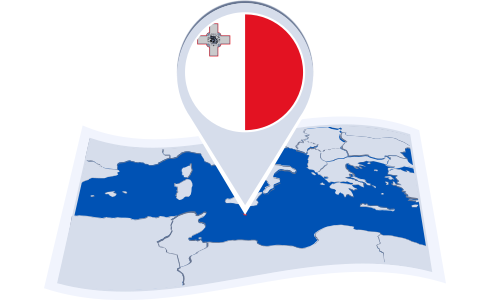
Strategic Role Of Malta
- Major EU iGaming hub
- Large concentration of licensed operators and suppliers
- Maltese licences remain a key EU market entry point

How The Framework Is Being Developed
Stakeholder Involvement
- MGA licensees
- International iGaming experts
- Foreign regulators' consultants
- Research institutions
- Malta Digital Innovation Authority (MDIA)
Risk Focus
- Algorithmic bias
- Lack of transparency
- Accountability gaps
Balancing Innovation And Security
What AI Improves
- Fraud detection efficiency
- Early problem gambling identification
- Reduced AML false positives
Risks of Uncontrolled AI
- Intrusive player profiling
- Biased automated decisions
- Encouraging unsafe behaviour
Human Oversight Is Mandatory
MGA Position
- No full automation of iGaming operations
- Human control over AI-driven decisions
- Clear responsibility and reporting lines
Alignment With The EU AI Act

Priority Technologies
- Financial monitoring algorithms
- Behavioural profiling systems
- Fraud detection tools
- Risk assessment models
Key Challenges Ahead
- Practical compliance testing (1–2 years)
- Dependence on third-party AI providers
Why Voluntary Participation Matters
Benefits For Operators
- Early adaptation to future rules
- Direct involvement in standard-setting
- Reduced regulatory risk
Key Takeaways
AI In iGaming
- Becomes a regulatory standard, not an option
- Requires transparency and human oversight
- Strengthens responsible gambling and compliance


Casino Market’s team explores key aspects of the document and offers advice on scaling gambling projects. We provide a vast array of solutions with proven commercial effectiveness.
Jurisdiction’s Agenda for 2026
The position and initiative of the Malta Gaming Authority (MGA) were officially confirmed by its Chief Executive Officer, Charles Mizzi. According to him, generative algorithms are increasingly being introduced into key operational and administrative processes.
The pool of tasks includes:
- casino marketing;
- risk management;
- customer support;
- fraud detection, etc.
Modern niche companies need to consider not only the pace of technological development but also the constantly evolving oversight requirements and standards for responsible work. The European AI Act has added another layer of complexity to industry participants’ current obligations.
Against this backdrop, the MGA is positioning the new monitoring tool as a voluntary solution focused on hands-on application and long-term benefit. The main goal of the regulator is to provide legal certainty and predictability when the technology finally moves from the experimental stage to basic operations.
Malta’s Role in Shaping Industry Standards
The authority’s initiative should serve as the starting point for developing a clear understanding of what responsible and safe use of generative algorithms in iGaming entails. Mr Mizzi noted that as AI becomes increasingly integrated into management tools and compliance systems, it is critical to clarify what constitutes acceptable practices.
The jurisdiction’s leadership role in this process is natural, as it is home to a significant number of European operators, content designers, and platform suppliers. Sportsbook and casino licensing in Malta remains among the main channels of entry into EU-regulated markets.
Joint Development and Risk Assessment
The supervisory approaches created by the MGA have repeatedly set the direction for the entire industry. Such influence has arisen largely through the hub’s structured oversight model and ongoing dialogue with the sphere’s stakeholders.
The AI-focused framework is also being drafted with the involvement of interested parties:
- existing licensees;
- international niche experts;
- consultants from foreign regulators;
- independent research centres and foundations;
- specialists from the country’s Digital Innovation Authority (MDIA).
In implementing this initiative, the supervisory body considers not only the potential benefits of artificial intelligence but also the risks for individual users and the market as a whole. According to Mr Mizzi, algorithmic systems can exhibit bias or lack transparency in decision-making, which directly affects trust and perceptions of industry integrity.
As the executive emphasises, by committing to developing a unified regulatory framework, the MGA aims to establish clear, understandable principles. These standards will boost loyalty to and interest in the legal market, while enhancing its overall resilience.
Balancing Functionality and Security
Few technological innovations have generated as much optimism as AI. Even at their current level of evolution, machine learning models can effectively address many important issues.
For instance, artificial intelligence handles the following tasks:
- improving fraud-spotting mechanisms;
- strengthening early ludomania detection tools;
- reducing false positives in AML monitoring systems.
Unregulated Implementation: Potential Consequences
Amid high expectations from businesses and society, insufficiently controlled AI services can exacerbate systemic risks.
Among them are:
- excessive, intrusive profiling;
- biased decision-making by algorithms;
- encouragement of unsafe behavioural patterns.
For authorities, user protection remains a key priority. The modern concept of responsible entertainment relies on high levels of automation and personalisation, in-depth player habit analysis, and real-time threat response. Each of these elements directly addresses issues of fairness, transparency, and accountability.
Human Factor’s Role in Monitoring Results
The MGA’s position remains unchanged: technological innovations are permissible only when they deliver tangible benefits to consumers and safeguard financial and operational processes. Commenting on this approach, Mr Mizzi noted that his agency focuses on hands-on achievements rather than grandiose statements.
In the CEO’s opinion, artificial intelligence can be an extremely useful tool for enhancing security and strengthening oversight. Nevertheless, this technology becomes unacceptable when it starts affecting vulnerable categories or blurring lines of responsibility.
Following a strict regulatory model, the MGA’s new framework does not envision fully automating iGaming processes. Instead, the approach relies on mandatory human involvement, with numerous scenarios of response to robot-made decisions. People are assigned a leading role in risk mitigation and reporting compliance.
MGA’s Initiative within the European AI Act
EU legislation applies to all commercial sectors, but recent developments have had the greatest influence on the gambling sector. Therefore, the Maltese body has decided to incorporate the key standards from the regional document into its AI governance project as soon as possible.
The MGA will focus on the following tech solutions:
- financial monitoring algorithms;
- behavioural profiling systems;
- fraud detection services;
- risk assessment tools.
From the authority’s perspective, pre-alignment with upcoming requirements will give operators sufficient time to prepare and adapt their offers to legal changes.
Mr Mizzi noted that, from the start, the system was shaped in accordance with existing protocols for threat detection and prevention, as well as the Act’s core provisions. This approach grants top-notch regulatory and administrative clarity, eliminating the need for future urgent platform upgrades.
According to the MGA’s estimates, the most pressing challenges are as follows:
- Compliance integrity testing. Issues related to the incorporation and proper use of artificial intelligence will emerge over the next 1–2 years. The legislation’s hands-on implementation phase will reveal all insufficiently thought-out nuances.
- Supply of generative technologies. In most cases, such solutions are developed by 3rd-party providers not directly involved in the gambling sphere. Nevertheless, responsibility for adherence to rules lies entirely with operators.
Advantages of Voluntary Participation
It is difficult to achieve strong contractual controls, transparency of use, and meaningful audit rights without open and free-will collaboration. That is why the principles of accessibility and consistency have become the foundation of the entire MGA program.
The executive claimed that voluntary collaboration is the 1st step toward creating a shared leadership space. Operators who engage early join the process of developing standards, rather than being confronted with them afterwards due to unexpected legal changes and tightening.
Jurisdictions with high levels of AI oversight eventually become synonymous with responsibility and trust. Openly demonstrating the working principles of generative algorithms contributes to relationships with both regulators and players. Early adopters set benchmarks for the entire industry and ultimately gain a solid competitive advantage.
Technology as a Tool for Strengthening Supervision
While the voluntary AI Governance Framework is being developed for operators, artificial intelligence algorithms have also been widely adopted within the MGA.
The agency uses these innovations for many purposes, such as:
- improving client support;
- strengthening regulatory functions;
- monitoring law compliance and reporting;
- increasing the efficiency of anti-fraud and AML tools.
Such technologies demonstrate the greatest benefit in certain fields:
- Combating financial violations. Cutting-edge modules can analyse vast amounts of data about fund transfers and identify virtually any anomaly.
- Experimenting to exchange experiences. The balanced application of tools allows the MGA to build effective operations and share results and successful practices with leading legal markets.
- Ensuring effortless supervision. AI helps assess the adherence of licensees’ policies to requirements. Automated reporting reduces errors caused by manual entry and speeds up general document flow cycles.
Additionally, the authority plans to launch an industry initiative to study the current and future use of artificial intelligence. The MGA’s goal is to create a user-friendly and flexible oversight model rather than imposing one-size-fits-all rules.
Mr Mizzi believes a deep analysis of the technology and its role in the modern iGaming environment is necessary. These processes will allow standards to evolve in line with the real market situation.
The executive’s agency is planning educational sessions to help operators better navigate new requirements and address common governance, bias, and transparency issues at once. Training transforms compliance into sustainable and productive collaboration.
The Main Things About AI Within iGaming Regulatory Practices
When implemented responsibly, artificial intelligence opens up enormous opportunities for operators. Even at its current level of development, the technology demonstrates significant effectiveness in handling various issues.
Among these tasks are:
- strengthening user protection;
- improving supervision compliance;
- supporting responsible gambling measures;
- improving anti-fraud, AML, and other security tools.
The MGA has adopted a proactive oversight strategy, taking a leading role in shaping the future development of the iGaming sphere. The authority’s goal is to establish Malta as a hub for transparent regulation. This approach will ensure the safe development of innovation and provide other supervisory bodies with convenient tools to monitor and protect players.
Feel free to contact our specialists for more information on this topic. We can also help you launch an online gambling business in Europe with proven AI services integrated.

Have questions or want to order services?
Contact our consultants:
- e-mail: manager@casino-market.com
- feedback form.
Check the information used to contact us carefully. It is necessary for your safety.
Fraudsters can use contacts that look like ours to scam customers. Therefore, we ask you to enter only the addresses that are indicated on our official website.
Be careful! Our team is not responsible for the activities of persons using similar contact details.