Latin America has become one of the fastest-growing regions in the global online gambling sector, driven by Brazil's regulated market and increasing legislative activity across neighbouring countries. As competition intensifies, businesses rely less on suppliers' marketing claims and more on the practical capabilities of their technology partners.
In this article, Casino Market’s experts investigate the prospects of iGaming platforms and the real requirements of operating in this region.
LatAm Growth: Key Achievements
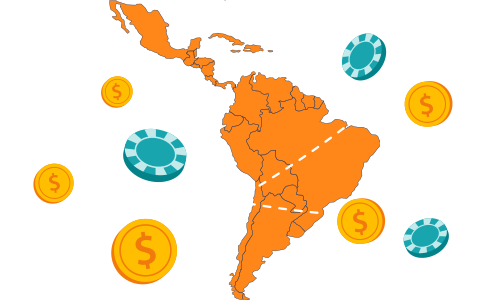
Brazil Has Reshaped the Market


Key Figures
- $7B GGR in the first full year
- $35B+ LATAM and Caribbean gambling market by 2026
- Regional CAGR: 26%
LATAM Is Not One Market

Colombia
- Regulated online gambling since 2016
Brazil
- Rapid growth after legalization
- Stricter requirements and higher tax pressure

Colombia and Peru
- Additional tax measures
- Rising financial uncertainty
Key Platform Requirements

Critical Factors:
- flexible architecture
- fast localization
- reliable compliance
- stable peak-load performance
- local payment integration
Why Turnkey Does Not Always Work

Common Problems:
- difficult local KYC integration
- slow product updates
- weak payment localization
- scaling limitations
- dependence on global provider roadmaps
Modular Architecture

Advantages:
- flexible frontend management
- fast payment integration
- adaptable bonuses and CRM
- scaling without overloading the core
- quick response to regulatory changes
Localization Goes Beyond Translation
Brazil
- Strong football interest
- Popularity of crash games and video bingo
- Critical role of local payments

Mexico
- Strong demand for video bingo
Colombia
- Gradual shift from sports betting to a broader gaming portfolio
Mobile-First as the Standard

Market Features:
- high mobile traffic
- frequent short sessions
- lower average spend
- dependence on local e-wallets
Hybrid Strategy

The Most Resilient Projects Combine:
- scalable technology core
- local product teams
- regional UX
- proprietary retention modules
- rapid regulatory adaptation
The Future of LATAM
Key Directions:
- responsible gambling tools
- self-limitation features
- modular systems
- moving away from legacy architecture
- user behavior monitoring


Key Takeaways
- LATAM requires deep localization, not template-based market entry
- Brazil has become one of the region's main growth drivers
- Modular architecture is more effective than rigid turnkey systems
- Success depends on fast adaptation to taxes, payments, and regulation
- The strongest platforms combine global technology with local market understanding


Brazil's regulated online gambling sector has reshaped the industry's perception of Latin America, positioning the region as one of the world's most attractive business opportunities.
According to H2 Gambling Capital, the country generated around $7 billion in gross gaming revenue during its first fully monitored year, while the wider LatAm and Caribbean market surpassed $35bn in 2026. Since the beginning of the decade, regional GGR has almost tripled, highlighting both the commercial potential and the pace of market development.
This expansion has shifted operators' priorities. Rather than simply entering new areas quickly, businesses now need technologies that support long-term growth while responding efficiently to changing commercial and governance requirements.
Platform Architecture: New Solutions
Regulatory volatility remains one of Latin America's defining characteristics. Licensing frameworks, taxation, and compliance conditions continue to evolve across several jurisdictions, creating an environment in which operators must be prepared for frequent change.
Recent developments illustrate this dynamic situation:
- Brazil introduced stricter licensing measures and higher levies shortly after the regulation took effect.
- Colombia's emergency consumption tax has increased operational pressure for approved operators.
- Peru implemented similar fiscal measures for its regulated market.
These changes have once again highlighted the importance of platform flexibility. Businesses need technology that allows regulatory updates, payment integrations, responsible gambling tools, and promotional mechanics to be modified quickly without disrupting day-to-day operations.
Consequently, the architecture of modern projects is moving away from rigid, one-size-fits-all solutions towards modular systems that simplify ongoing growth. Many brands are also adopting hybrid technology models that combine tried-and-tested third-party infrastructure with in-house developments. In this way, businesses gain greater control over LatAm-specific functionality while maintaining the platform’s stability.
Speed of Product Development
Rapid product development has become another key differentiator in Latin America. Brazil alone now hosts dozens of licensed operators, putting constant pressure on operators to improve player acquisition, retention, and user experience. In this environment, lengthy development cycles can quickly become a competitive disadvantage.
Platforms should support continuous optimisation across multiple areas, including:
- customer onboarding;
- promotional campaigns;
- user journeys;
- interface improvements;
- engagement features.
The ability to implement new functionality quickly enables operators to respond more effectively to regulatory changes, customer expectations and competitor activity. Rather than relying on periodic platform upgrades, many businesses are prioritising continuous development supported by agile internal teams and flexible technology architecture.
Choosing the Right Supplier
Technology alone is no longer enough to guarantee operational success. Beyond stability, security and regulatory compliance, operators increasingly expect partners to provide responsive support, regional expertise and ongoing product development.
Key evaluation criteria include:
- local market knowledge;
- integrations with regional payment and service providers;
- dedicated technical support;
- efficient delivery of new features and compliance updates.
Many global platform providers manage multiple regulated markets through centralised development teams. Although this approach improves operational efficiency, it can also delay enhancements in emerging jurisdictions, as development priorities naturally shift towards sectors that generate the highest revenues.
For casinos expanding across Latin America, suppliers with regional expertise and more flexible development structures are often better equipped to respond to evolving commercial and regulatory demands.
Regional Adaptation
Selecting the right platform is only the beginning. The way technology is implemented and refined for the local market ultimately determines how effectively it meets the needs of both casinos and players.
To adapt quickly, operators should focus on the following aspects:
Localisation

While translating a platform into Spanish or Portuguese is essential, player expectations differ significantly between markets. Content preferences, payment behaviour and onboarding journeys often have a much greater impact on engagement than regional branding alone.
An effective localisation strategy should include:
- market-specific game portfolios;
- tailored promotional mechanics;
- local payment methods and verification processes;
- regionally relevant customer support;
- personalised player journeys.
Game preferences also vary across the region. Certain products perform exceptionally well in specific markets while attracting considerably less interest elsewhere. For example, video bingo has historically been a popular category in Brazil, while other countries have developed different player preferences based on their own market evolution.
For operators, localisation should therefore focus on delivering the appropriate content to the right audience rather than creating a standard platform for the entire region.
Supplier Capabilities
Many providers advertise region-specific functionality, but successful implementation depends on how well these features perform in live environments. This is particularly relevant for compliance tools, payment integrations and identity verification, where operational efficiency directly affects player acquisition and retention.
Operators should assess suppliers based on several practical factors:
- reliability of compliance solutions;
- maturity of KYC and onboarding systems;
- quality of local integrations;
- speed of feature deployment;
- long-term product roadmap.
Rather than selecting suppliers with the longest list of features, operators increasingly benefit from partners capable of adapting quickly as regulations and market demands evolve.
Scalability
Rapid market growth places considerable pressure on platform infrastructure. Brazil's regulated launch demonstrated how quickly customer volumes can grow, exposing weaknesses in systems that were not designed to adapt.
A scalable platform should support:
- increasing player traffic;
- higher payment volumes;
- expanding game portfolios;
- multiple regulated markets;
- seamless third-party integrations.
Modular architecture has become increasingly popular because it enables operators to scale individual platform components without disrupting the wider ecosystem. This flexibility allows businesses to introduce new services, enter additional jurisdictions and accommodate future growth more efficiently.
Player Behaviour
One of the biggest mistakes operators can make is assuming punters’ habits remain constant. One example is Colombia, where gamblers preferred sports betting and showed little interest in slots. Within a few years, the situation changed completely. Rather than relying on long-standing assumptions, operators should continuously monitor customer behaviour through data analysis and testing.
Key areas to evaluate include:
- changing game preferences;
- betting patterns;
- payment behaviour;
- feature engagement;
- promotional performance.
This ongoing analysis enables operators to refine their offering, ensuring product decisions are based on current player demand rather than historical market stereotypes.
The Main Things about LatAm iGaming Platforms
Latin America is positioned as one of the most attractive growth regions for the global online gambling business, but sustainable success requires considerably more than entering newly regulated markets. As competition increases and regulations continue to develop, platform capabilities have become a key differentiator for operators.
The main characteristics of successful LatAm platforms include:
- flexible architecture that supports rapid regulatory and commercial updates;
- scalable infrastructure that grows alongside the business;
- meaningful localisation tailored to individual markets rather than the whole region;
- strong partnerships with suppliers that understand local requirements;
- continuous product development driven by changing player behaviour;
- reliable compliance, payment and identity verification solutions.
Technology alone, however, is not enough. Successful operators also need to monitor ongoing governmental requirements, analyse customer habits and respond quickly to shifting market conditions. Platforms that combine technical flexibility with ongoing operational optimisation are likely to be better prepared for both new sector opportunities and future regulatory changes.
Casino Market’s specialists will assist you at every stage of launching a profitable iGaming project in a Latin American jurisdiction or expanding your business in this region. Feel free to contact our team to order the development of a scalable online gambling platform from scratch.

Have questions or want to order services?
Contact our consultants:
- e-mail: manager@casino-market.com
- feedback form.
Check the information used to contact us carefully. It is necessary for your safety.
Fraudsters can use contacts that look like ours to scam customers. Therefore, we ask you to enter only the addresses that are indicated on our official website.
Be careful! Our team is not responsible for the activities of persons using similar contact details.